Introducing .410 Bore, 20 Gauge and 16 Gauge — plus a look at the development and durability testing behind them.
Hello,
With summer winding down, it seems like a good time to look back at what has been
happening over the last few months.
One of the larger projects at Ram-Shell has been the development and testing of
a new line of shotgun calibers using the same basic operating principle as the
12 Gauge Ram-Shells introduced at the beginning of this year.
The process took somewhat longer than expected. Material and tooling availability
presented a few challenges, but perhaps the most interesting engineering problem
was simply making everything smaller while still reliably using a rimfire charge.
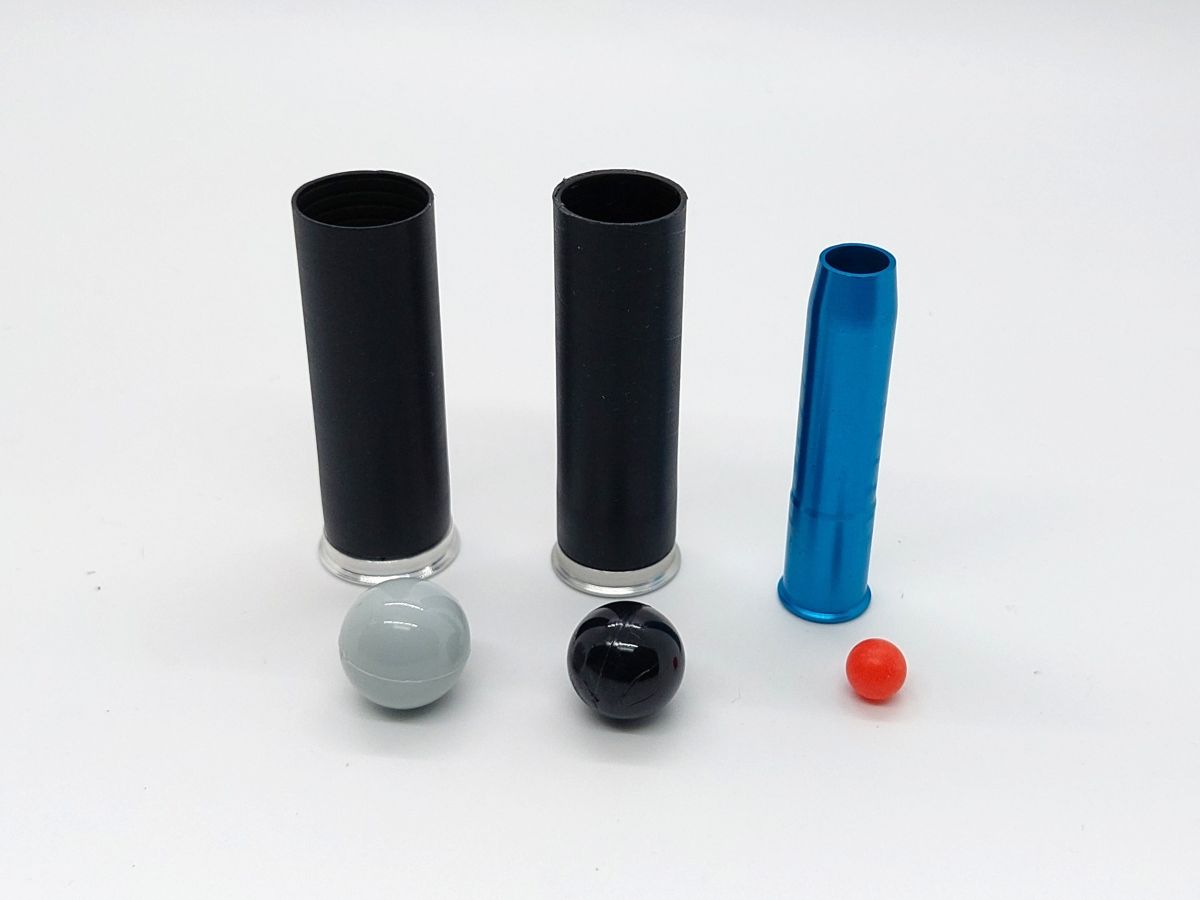
Introducing .410 Bore, 20 Gauge and 16 Gauge
Four additional calibers were initially considered. The fourth, 28 Gauge, has
been put aside for now due to relatively limited interest. The design work and
test parts were completed, so it isn't necessarily gone forever, but I decided
to hold off on the additional production tooling (and associated cost) for the time being.
The new 20 Gauge and 16 Gauge versions are directly scaled from
the 12 Gauge in terms of their basic construction. Rim dimensions were developed
from SAAMI specifications and slightly adjusted to match commercial cartridges.
The .410 Bore required a somewhat different approach. Its small
diameter leaves very little room to maintain the necessary offset between where
a centerfire firing pin normally strikes the cartridge and where it needs to
strike the rimfire blank.
A Return to a Plastic Hull — With a Different Material
Another goal was to keep the cost of the new calibers reasonable, particularly
because their initial production volumes are expected to be smaller. That led
back to the idea of using a plastic hull for the 16- and 20- Gauge versions.
The first-generation Ram-Shell used a CPVC hull as a compromise between strength
and cost. As discussed in previous updates, that ultimately proved to be the
wrong material choice and resulted in the voluntary replacement of those units.
With that lesson very much in mind, the new design needed a material that was
durable, still reasonably economical and, most importantly, capable of tolerating
repeated impact.
The solution was ABS (Acrylonitrile Butadiene Styrene).
ABS is a tough, high-impact thermoplastic that proved well suited to this
application. Other candidates, including LDPE, UHMW-PE, POM and Nylon, were considered, but
did not produce sufficiently dimensionally accurate parts when CNC machined or failed to provide satisfactory long-term performance.
Since suitable ABS stock is most readily available in black, I decided to pair
it with a clear/silver aluminum rim. The aluminum is still anodized for additional
wear protection.
The .410 Bore Took a Different Path
The .410 presented another challenge. There simply isn't enough room for a
practical plastic hull while retaining a useful projectile diameter and the
durability expected from a reusable cartridge.
The result is a single-piece body machined from solid 6061-T6511
aluminum rod.
I initially hoped to use a .40-caliber or similar projectile, but that introduced
another problem: the smaller and more aggressive feeding geometry could damage
the cartridge after only a few uses.
The final design instead uses an 8 mm plastic ball. This allows
approximately a 1/16-inch wall thickness for durability while leaving enough
room for a small necked section. The overall cartridge length was also reduced
slightly so that it can reliably feed from a magazine-fed .410 AR-15 upper.
It is worth emphasizing that this means feed, not semi-automatic
cycling. The Ram-Shell still requires manual cycling between shots.
To better withstand the scratching and handling associated with magazine feeding,
the .410 aluminum body is hard anodized.
Three New Additions
These three calibers now join the growing selection of Ram-Shell training
cartridges. Initial production quantities will be somewhat limited while I
get a better sense of demand, but production can be expanded as interest grows. All three products are immediately available through the website.
Lastly, in terms of projectiles that these launch, the 16 Gauge uses the smaller (.67 inch) gray hard nylon projectiles (these also fit the 12Ga) which are a very close fit to the barrel. The 20 Gauge uses a smaller, .61 Caliber black, hard nylon projectile that has a small gap within the barrel. Both of these generate high muzzle energies which are not to be underestimated.
If you see one of the new products marked Backorder, don't be
too concerned. In most cases it simply means finished units aren't currently
boxed and sitting on the shelf. Depending on inventory, either completed
components will be packaged shortly or additional parts will be machined and
assembled as soon as possible.
Durability Testing
Given the experience with the original CPVC hull, durability testing of the
new ABS design was particularly important.
For this test I used a (Imported) Mossberg SA-20 shotgun. As noted above, the
Ram-Shell does not cycle the semi-automatic action.
The test conditions were deliberately more demanding than normal handling:
- Level 4 charges
- 30 lb projectile insertion force — substantially more than normal finger pressure
- 20 consecutive discharges
- After every discharge, the shell was dropped approximately 5 ft onto a concrete floor
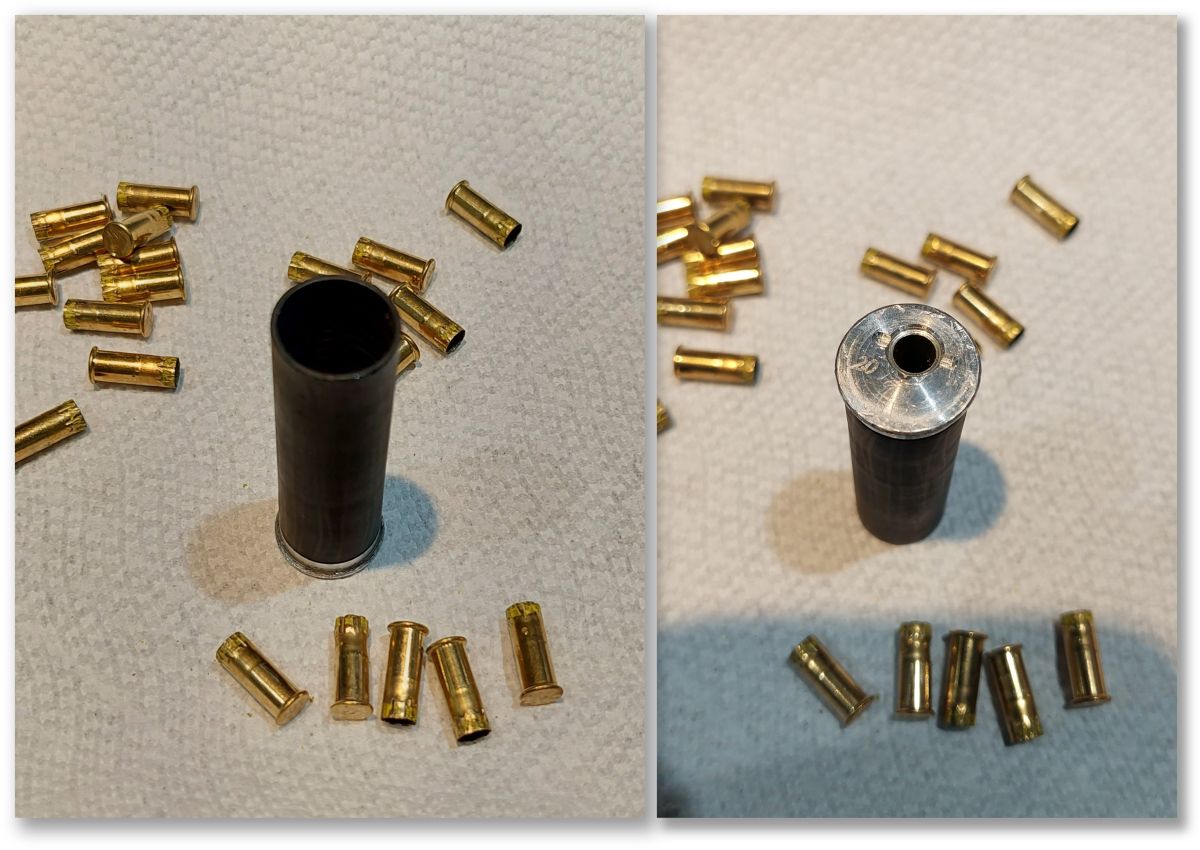
The result is probably best illustrated by the photo above.
After 20 discharges, no damage to the ABS hull was observed.
The only visible wear was scratching on the aluminum rim from feeding the shell
from the magazine into the chamber and extracting it afterward.
All 20 charges also discharged successfully on the first attempt.
There will always be more to learn from actual use, but this test gives me much
greater confidence that ABS is the right material for these new configurations.
Growing the Ram-Shell Community
I do have one small request.
If you've been enjoying Ram-Shell, please consider letting other people know
about it. And if you haven't been happy with it, I'd genuinely like
to hear that too — particularly if there is something I can do to make it right.
Word of mouth is especially valuable for a product like this because advertising
through the major search platforms is heavily restricted for this product
category.
If you're willing to leave a public review on a forum or review site where you
already participate, that is always appreciated. You can also leave feedback
directly on the Ram-Shell website:
Ram-Shell Customer Testimonials & Feedback
Every review and recommendation helps other people discover the product and
helps me understand where to take it next.
Comments?
As always, let me know what you think. I'm happy to hear from users and always
up for a brief email exchange.
Best,
Ben
Ram-Shell